About circulation in the human body
In the human body, circulation begins at the heart and routes through arteries which branch smaller and smaller down to where circulation drains
… through the walls of capillaries in beds of capillaries. The human body has millions of artery ends, capillary beds, and vein starts (at the exit ends of the capillary beds).
… into the open space around cells: open space in the body is also called the interstitium or interstitial space, and its fluid is 20% of body weight. Open space is where exchange takes place. Nutrients and oxygen are exchanged for metabolism and cell wastes, and carbon dioxide. 20% of open space fluid is picked up by lymphatic capillaries rather than circulatory capillaries, and routed through lymphatic veins and lymphatic nodes, where the blood is cleaned.
… and is all returned to circulation in veins that lead back to the heart.
About Vitamin D3
Electrolytes in circulation in the human body power the steady stream of chemical reactions necessary to maintain the body’s tissues and enable all of human behavior. These electrolytes include sodium+, potassium+, calcium2+, magnesium2+, chloride−, hydrogen carbonate−, monohydrogen phosphate2−, and dihydrogen phosphate− ions.
Calcium phosphates form spontaneously from the circulating calcium (Ca2+), hydrogen phosphate (HPO42−), and dihydrogen phosphate (H2PO4−) ions at a slow but steady rate, stop moving through circulation, and accumulate throughout our bodies in open space. This spontaneous formation/dropout/accumulation of calcium phosphates happens continuously in open space from before birth to death. Calcium phosphates accumulation is increased during fever, during times of metabolic imbalances, during pregnancy, at and around sites of injury, during restricted/limited activity (too much lying down, sitting, standing, etc.), and during long stretches of repetitive actions (too much working, practicing, etc.). Calcium phosphates cannot return to circulation on their own, they must be broken into their component parts, calcium (Ca2+) and phosphate (PO43-) ions, and pushed back into circulation. Of the many tasks vitamin D3 does in the body, breaking down and returning calcium phosphates from open space back to circulation is vitamin D3’s most important task and there must be plenty of vitamin D3 in circulation for vitamin D3 to get all its work done.
About how to get Vitamin D3 into circulation
The best way to get vitamin D3 into the body and into circulation is to route it in through the skin. The body makes vitamin D3 in its skin and safely handles all the vitamin D3 it makes. It makes vitamin D3 through exposure to sunlight with 295-300nm wavelength ultraviolet-B light in it. Vitamin D3 is hydrophobic (“water fearing”). Blood has a saltwater base (what vitamin D3 fears), so the vitamin D3 doesn’t move until it is picked up and carried into and through circulation by vitamin D-binding protein (made in the liver). In contrast, ingesting vitamin D3 puts it through the body’s digestive system, which results in huge losses (estimated 50-80 percent losses). And it passes through the digestive system unchecked, which can result in dangerous surges of vitamin D3 in circulation, a condition that creates hypercalcemia (which is why the FDA recommends no more than 5,000 IU of vitamin D3 a day when vitamin D3 is taken orally).
Whether vitamin D3 is produced naturally in skin or is added to skin, once attached to vitamin D-binding protein vitamin D3 is freed to move out of skin and through circulation under the body’s full control. On passing through the liver vitamin D3 is converted to calcidiol:

The conversion of vitamin D3 to calcidiol is mandatory in the liver: it occurs when vitamin D3 molecules encounter the liver enzyme CYP2R1 in endoplasmic reticulum in the liver (also called “the principal vitamin D 25-hydroxylase”), or when vitamin D3 molecules encounter the liver enzyme CYP27A1 in mitochondria in the liver (also called “another vitamin D 25-hydroxylase”).
The next and final conversion of vitamin D3 is the addition of a second hydroxyl in the kidneys, which converts calcidiol to its biologically active form (to calcitriol (1,25(OH)2D3)):

Very little biologically active vitamin D3 (calcitriol or 1,25(OH)2D3) is ever seen in circulation, because it is produced only on demand and is put to work immediately by vitamin D3 receptors which are located throughout the body, so has little opportunity to circulate. When active vitamin D3 begins increasing circulating calcium ions (Ca2+) the body also begins producing calcitonin to keep the amount of circulating calcium in check (to prevent hypercalcemia (overdosing)).
Active vitamin D3
– 1,25(OH)2D3 (active vitamin D3 or 1,25-dihydroxycholecalciferol) regulates calcium and phosphorus homeostasis (the calcium and phosphorus balance in circulation) and is essential for maintenance of bone mineralization. As part of this role, active vitamin D3 increases calcium and phosphorus uptake in the intestine. Calcium and phosphorus homeostasis, calcium and phosphorus uptake, and bone mineralization have been known roles of active vitamin D3 in the body for more than one hundred years now.
– About two decades ago, 1,25(OH)2D3 was discovered to be a “transcription controller,” a protein that turns the transcription of genes on and off. As research in the genetics frontier of modern medicine advances, active vitamin D3 is now described as a “transcription factor” that promotes/discourages and speeds/slows the transcription of hundreds of genes, working alone, or working with other transcription factors to direct cell division, cell migration, cell organization, cell growth, and cell death throughout the life of the cell, transcription, first to messenger RNA, and then to new protein.
– 1,25(OH)2D3 reduces the occurrences of colorectal, breast, and prostate cancers, autoimmune diseases (including type 1 diabetes mellitus, multiple sclerosis, rheumatoid arthritis, and systemic lupus erythematosus), type 2 diabetes mellitus, limits cognitive deterioration and disease progression in subjects with neurodegenerative diseases, protects the unborn in pregnant women from several adverse effects, reduces the incidence and severity of the coronavirus disease (COVID-19), offers promising improvements in the management of atopic dermatitis (eczema) and Crohn’s disease, and influences the immune system, through the vitamin D receptors (VDRs) that are expressed in several types of white blood cells, including monocytes and activated T and B cells.
–1,25(OH)2D3 also creates calcium-binding proteins and phosphatases to break up stable calcium (2Ca) and calcium phosphates that are accumulating continuously throughout the body, from before birth to death, and returns the useful calcium and phosphate ions they spontaneously form from back to circulation. Unattended, this stable calcium and these calcium phosphates clog/slow circulation (from within the open space where they accumulate). Free circulation is restored when stable calcium and calcium phosphates are cleared (removed from open space). 1,25(OH)2D3 stays busy throughout the body doing may things. 1,25(OH)2D3 must be in plentiful supply to get all its work done.
What Vitamin D3 does
The body is nerve, muscle, bone, all the support systems nerve, muscle, and bone need, and fluid filled open space (20% of the body by weight). Vitamin D3 uses the phosphatases and calcium-binding proteins it creates to clean open space. Calcium phosphate accumulations clog open space (where inert calcium and calcium phosphates accumulate). As a result, the body, can’t get nutrients, especially oxygen, to cells efficiently. Clear, direct, and straight forward nerve and muscle actions are impeded. Where there are large accumulations of calcium phosphates in open space, circulating macrophages combine and make themselves into multinucleated macrophages (Figure 4), to surround (using neoplastic, “new form” membrane), break up, dissolve, encapsulate, and transport away calcium phosphate masses, another tool the body uses to thoroughly clean open space in the body.
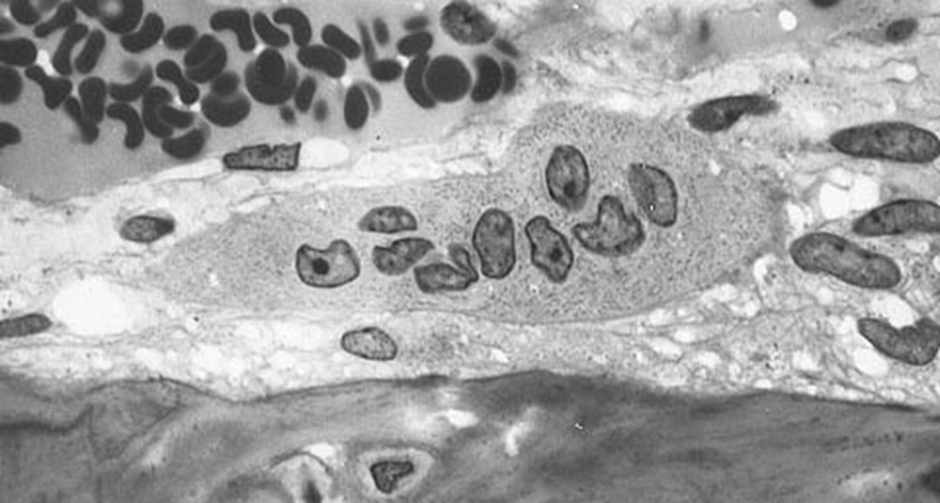
Figure 3: A multinucleated macrophage looking for calcium phosphates to consume. This one macrophage will divide into 10 cells to surround some spontaneously formed, dropped out, and accumulated calcium phosphates, break it down to calcium2+ and phosphate ions3-, then put the ions back into circulation.
What to do with Vitamin D3
WorkoutD is a method of rubbing vitamin D3 (in paste form) into your skin. Once a day rub on up to 200,000 IU of vitamin D3 200,000 IU should be more vitamin D3 than you can use, no matter how active you are (your body will store what’s left over). It will be brought into circulation all day as vitamin D-binding protein is made available to pick the vitamin D3 up and circulate it. Target areas where calcium phosphates readily collect, such as at shoulders, elbows, wrists, hips, knees, and ankles.
WorkoutD with exercise extends open space calcium phosphates cleanup to every corner of the body. You will be working locally cleaning open space around cells, and working system-wide using circulating multinucleated macrophages to locate and remove calcium phosphates masses throughout your body. Exercise for circulation (walk or run).
J. Dalen, at WorkoutD